
Walk through the lot behind the Walking Horse Hotel in Wartrace, Tennessee, past the overgrown grass and someone's backyard shed, and you will find a headstone. It marks the grave of a horse named Strolling Jim. He died decades ago. Nobody alive watched him run. But every August, a hundred thousand people drive past this spot on their way to Shelbyville, seven miles down the road, to see what Strolling Jim started.
He was the first.
In September 1939, on the Shelbyville High School athletic field, a three-day horse show with 27 classes crowned Strolling Jim the inaugural World Grand Champion Tennessee Walking Horse. There was no stadium. No Calsonic Arena. No $2 million corporate donation. There were 200 citizens who had each pledged ten dollars to underwrite a two-thousand-dollar show, and a group of civic-minded men from the Lions Club and the Rotary Club who believed Bedford County deserved something to call its own. They produced a twelve-thousand-dollar spectacle on a two-thousand-dollar budget, without a single outside contribution, and a tradition was born that has not missed a year since. It may be the longest-running annual event in Tennessee.
A Hay Trip to Winchester
The story begins, like so many Tennessee stories, with a man going somewhere else and coming back with an idea. W. Henry Davis of Wartrace had driven to Winchester to buy hay. While he was there, he noticed a Crimson Clover Festival on the courthouse square. The thought arrived unbidden. Why couldn't Bedford County have a festival of its own?
Davis returned to Shelbyville and walked into Peoples National Bank. He spoke with William L. Parker, who would later become one of the Celebration's corporate officials. The idea gained traction. The following Thursday night, a small but distinguished group assembled at the Lions Club: R.T. Murchison, Charles Pearson, Floyd Carothers, Fred Walker. Dr. W.H. Avery made a motion to appoint a committee to enlist the support of other clubs in town. Lions Club president Freeman Fly named his committee. The Rotarians named theirs.
Ben A. Green, a late historian of the breed, called the first Celebration a "community miracle." The phrase has stuck for 87 years.
Black Allan and the Rocking-Chair Gait
To understand why a horse show could galvanize an entire county, you have to understand what a Tennessee Walking Horse is. The breed traces to a single foal born on September 17, 1886, a black colt named Allan F-1, though everyone called him Black Allan. His breeder thought so little of him that the horse changed hands several times for trivial sums. Black Allan died in 1910, never having achieved anything that his breeders would have called greatness. But his genes carried something that farmers in the hills and hollows of Middle Tennessee had been trying to breed for generations: a gait. The running walk. Four beats. Smooth as a rocking chair on a flat floor. A horse you could ride all day across broken ground and still feel when you dismounted.
Plantation owners had been crossing Narragansett Pacers, Canadian Pacers, Standardbreds, Morgans, and Thoroughbreds since before the Civil War, chasing that gait. Black Allan happened to lock it into a bloodline. In 1935, four years before the first Celebration, the Tennessee Walking Horse Breeders' Association established a registry. The breed was official. The show would make it famous.
The early families of the Walking Horse world treated breeding the way some people treat religion. The Brantleys. The Hunters. The Womacks. The Wilsons. The Dements. The Grays. A man named Dement exhibited his walking horse at the Franklin County Fair by riding with a water glass balanced in his hand, proving the gait was so smooth that not a drop would spill. In those days, horses were trained through mud. Mud was the medium. A smooth-riding horse was not a luxury. It was born out of necessity, the difference between a farmer who could work his land all day and one who couldn't.
Governor Prentice Cooper, whose hometown was Shelbyville, championed the festival. The state of Tennessee kicked in money for ribbons, trophies, and premiums. The Celebration had its home.
From High School Bleachers to Calsonic Arena
What grew from that first show on a high school athletic field defies easy summary. In 1939 there were 27 classes. By 1950, 46. By 1970, 65. By 2003, 152. Three days became eleven. The Celebration grounds were built nine years after the show began, originally on the edge of town, then moved to the middle, on 50 acres that quickly proved inadequate. The first stadium seated 12,000 and housed 500 horses. By 1973, the stadium held more than 25,000 spectators and 1,700 horses. Parking was always impossible. People walked. They still walk.
In 1990, the 51st Celebration opened the Calsonic Arena on the grounds. Calsonic Manufacturing Corporation donated $2 million of the $3.2 million construction cost. The arena was promoted as America's largest and newest equestrian facility. It still anchors the Celebration grounds today at 1110 Evans Street.
Donuts, Bowties, and Downtown Thunder
The numbers tell one story. The feeling tells another.
Walk through downtown Shelbyville in late August and the town hums. Horse trailers line the roads. Riding boots click on the sidewalk. Vendors, most of them local civic groups, sell sugary homemade donuts and funnel cakes from tents. An announcer's voice echoes from the outdoor arena under the stars. People wear ballgowns to a horse show. They wear bowties and blazers. The atmosphere grows dense with excitement as each class fills the ring. The silence of the former moments gives way to a roar when the gate closes and the horses enter.
The Celebration draws more than 270,000 visitors to Shelbyville each year. Over 100,000 tickets are sold. The association that runs it reported $5.3 million in total revenues in 2024, against $4.7 million in expenses, with total assets of $9.8 million. But the money that matters most is the money that stays. The vendors are local. The hotels fill. The restaurants fill. For eleven nights, a town of 24,000 people becomes a city.
The Shadow Over the Ring
Then there is the part of the story that the Chamber of Commerce brochure will not tell you.
The Tennessee Walking Horse Celebration has lived under a shadow for decades. The breed's signature high-stepping gait, the "Big Lick," can be amplified by training methods that cross into cruelty. Soring, the practice of applying caustic chemicals or sharp objects to a horse's hooves and pasterns to make each step painful enough to produce an exaggerated lift, became endemic in the industry. In 1970, Congress passed the Horse Protection Act specifically to outlaw the practice. Enforcement proved difficult. In 2006, USDA inspectors disqualified the majority of qualifying horses at the Celebration, and the show nearly collapsed under the weight of the controversy. In 2012, a trainer named Jackie McConnell was convicted of soring, and hidden-camera footage aired on national television. A bill called the PAST Act, the Prevent All Soring Tactics Act, has been introduced in Congress repeatedly to eliminate the action devices and shoeing packages that critics say enable abuse. The industry has adopted reforms, mandatory inspections, stricter penalties, and a new emphasis on the flat-shod, naturally gaited performance horse. But the tension between tradition and conscience has not fully resolved. It may never fully resolve.
This is the complicated inheritance of Shelbyville. The town that calls itself the Walking Horse Capital of the World is also the town where the deepest scars of that industry are visible, year after year, under the lights of the same arena where Strolling Jim was crowned in 1939.
Four Generations on the Pressed Dirt
And still they come.
Families who have attended the Celebration for four generations pack the same box seats their great-grandparents bought. Trainers who have devoted their lives to the breed ship horses from California, from Texas, from Florida, from Michigan, to compete on a pressed dirt track in Middle Tennessee. A horse is crowned World Grand Champion on the final Saturday night, and the green winner's circle, the one every trainer dreams of, is the same patch of ground it has been since the stadium was built.
The Quiet Grave Behind the Hotel
Seven miles away, in Wartrace, the headstone behind the hotel stands in a field that grows wild. The Walking Horse Hotel, built in 1917, was the base for trainers who helped create the breed. The Walking Horse Museum sits across the street, free admission, donation optional. The grave of Strolling Jim and the grave of a dog lie near someone's backyard shed. The hotel itself has been through foreclosure, through decline, through the slow erosion that time inflicts on buildings that outlive their purpose.
But the show that Strolling Jim won goes on. Eighty-seven consecutive years. No interruption. Not for a world war. Not for a pandemic. Not for scandal.
Shelbyville built the Celebration. The Celebration, in turn, built Shelbyville. And the horse buried behind the hotel in Wartrace, the one nobody alive remembers watching run, is still the reason 270,000 people come to town every August, still the reason this small county seat in Middle Tennessee has a name that means something to horse people on every continent.
Two hundred citizens. Ten dollars each. One man's idea on a hay trip to Winchester. That is all it took.
Community Discussion
Sign in to join the discussion.
Be the first to comment on this story.

David Stemper
Editor & Publisher, Shelbyville Connect
David Stemper is a photographer, writer, and Bedford County resident who covers local history, community events, and everyday life in Shelbyville, Tennessee. His work spans historical research, local business features, and community storytelling rooted in primary sources and firsthand knowledge of the area.
About Us →More Stories to Read
The Day 10,000 Cavalry Charged Through Shelbyville: A Town Called Little Boston and the Battle Nobody Remembers
Read more
Jack Daniel Called Him the Best. Shelbyville Put His Name on the Building.
Read more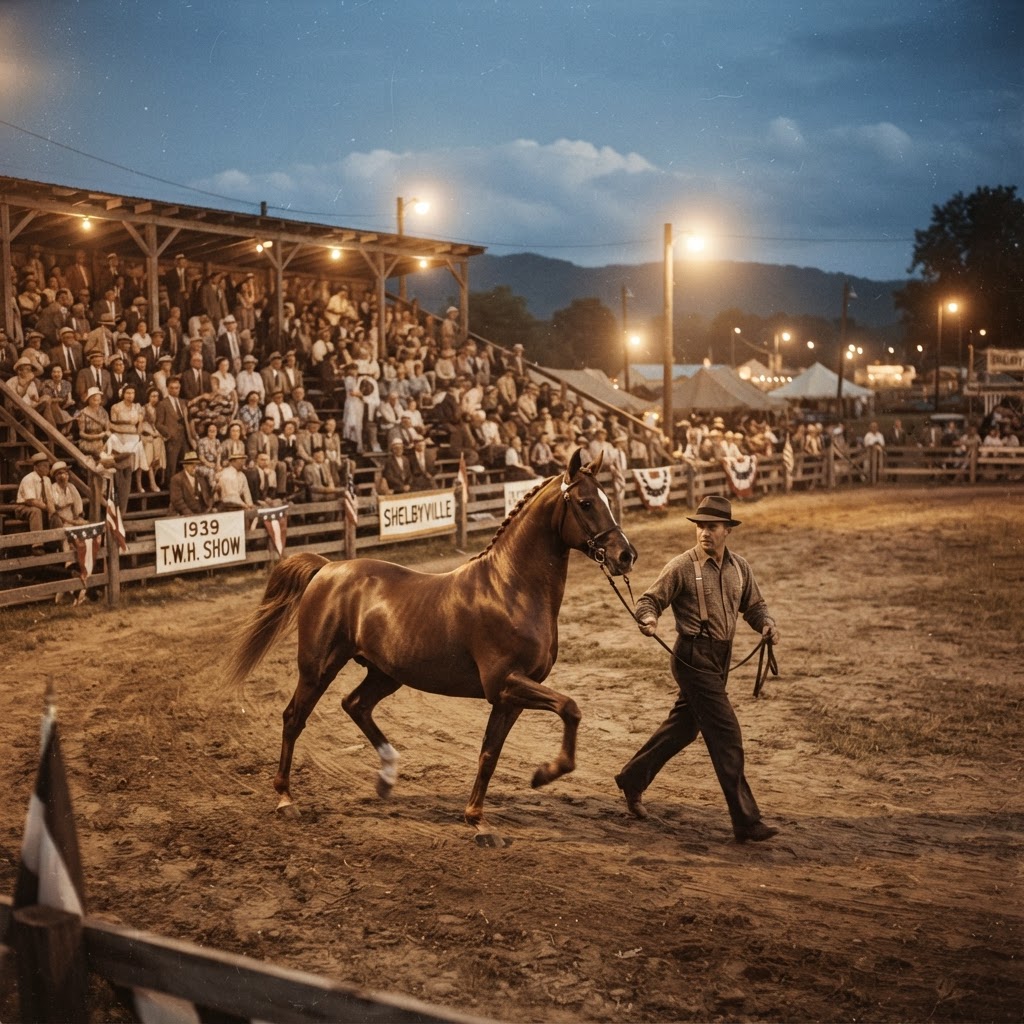
The Hay Run That Built Tennessee's Grandest Horse Show
Read moreFrequently Asked Questions
When was the first Tennessee Walking Horse Celebration held?
The first Celebration was held in September 1939 on the Shelbyville High School athletic field. It lasted three days and featured 27 classes. Strolling Jim was crowned the first World Grand Champion Tennessee Walking Horse.
Who founded the Tennessee Walking Horse Celebration?
W. Henry Davis of Wartrace, Tennessee, is credited as the Father of the Walking Horse National Celebration. He conceived the idea after seeing a Crimson Clover Festival in Winchester, Tennessee, while on a trip to buy hay. He returned to Shelbyville and rallied the Lions Club and Rotary Club to organize the first show.
Where is Strolling Jim buried?
Strolling Jim is buried behind the Walking Horse Hotel in Wartrace, Tennessee, about seven miles from the Celebration Grounds in Shelbyville. A headstone marks the grave, and the Walking Horse Museum is located across the street.
How many people attend the Celebration each year?
The Celebration draws more than 270,000 visitors to Shelbyville over its 11-day run, with over 100,000 tickets sold annually. The show features more than 2,500 entries across approximately 150 classes.
What is soring and why is it controversial?
Soring is the practice of applying caustic chemicals or sharp objects to a horse's hooves and pasterns to create an exaggerated high-stepping gait. Congress passed the Horse Protection Act in 1970 to outlaw it, but enforcement has been difficult. The industry has adopted reforms including mandatory inspections and a renewed emphasis on flat-shod, naturally gaited horses.