
A Horse Walked Into a Floodlight
On the evening of September 7, 1939, a former plow horse named Strolling Jim walked into a floodlight at the old Central High School practice field in Shelbyville, Tennessee, and made a kind of history that nobody in the crowd of forty thousand quite knew how to name yet. It was the first night of what would become the Tennessee Walking Horse National Celebration. Strolling Jim, a three-year-old gelding with no notably distinguished bloodline, had spent his early career doing the kind of work that horses do in Bedford County. Pulling. Hauling. Standing in pastures. Now he was walking in a slow, gliding, head-nodding run-walk, the signature gait of a breed that Middle Tennessee had been quietly perfecting for thirty years, in front of a crowd that filled the bleachers and overflowed onto the grass. He won. The floral horseshoe went around his neck, draped by identical twins named Mary and Margaret Wallheiser, and Tennessee had its first World Grand Champion Tennessee Walking Horse.
The Day Henry Davis Went to Buy Hay
That part of the story is well known around Bedford County. The part that gets told less often begins months earlier, on a spring day, when a horseman named Henry Davis drove from Wartrace to Winchester to buy hay.
Davis was a trainer, a breeder, a judge, and a promoter, the sort of person whose enthusiasm for the Tennessee Walking Horse was less a profession than a creed. He made his living partly from horses and partly from sheer conviction that the breed deserved a larger stage than the county-fair circuit could offer. He had no script for what he did next.
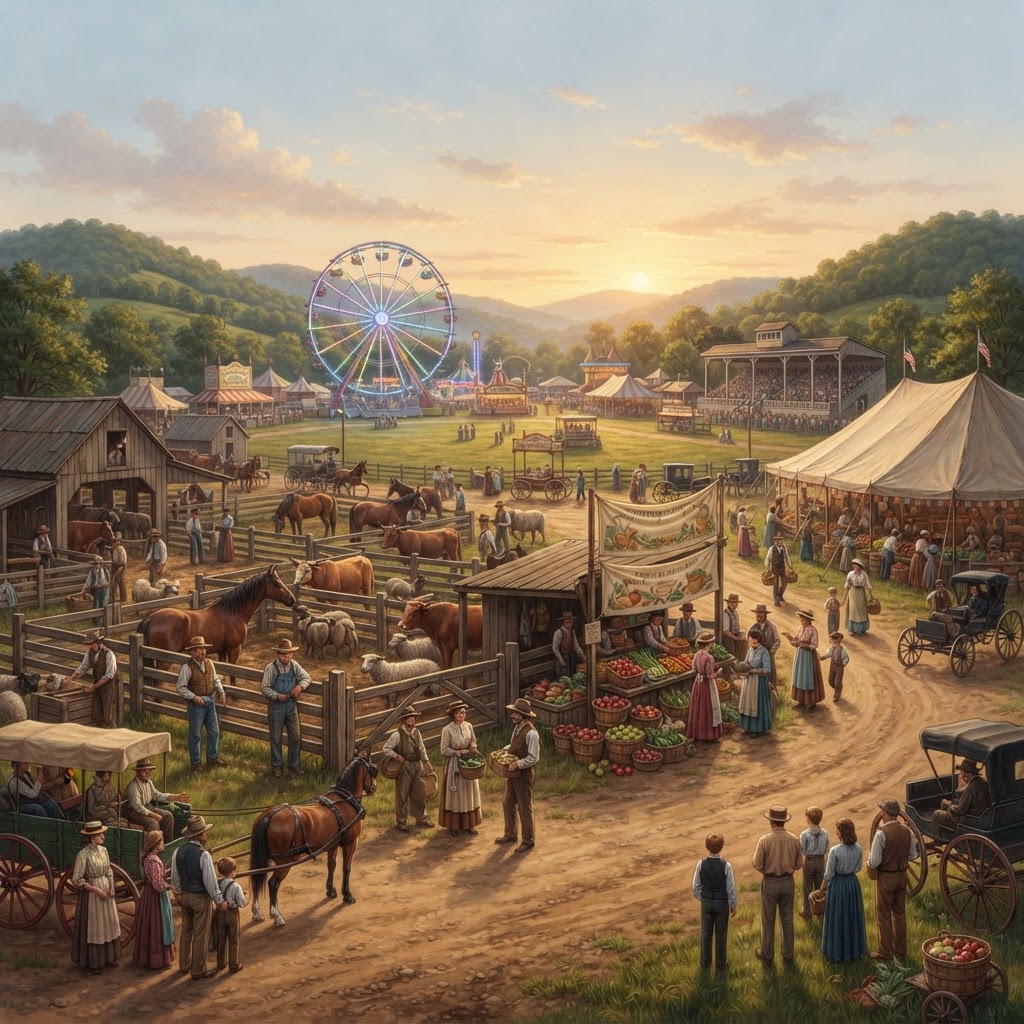
He went to Winchester hoping to purchase hay. Instead, he wandered into the Crimson Clover Festival, a community celebration built around the year's crimson clover bloom, and what he saw there, in his own words, "got under his skin." He came home thinking about it. Writing in the 1953 edition of Blue Ribbon magazine, Davis described the spring trip as the moment a vision began to form. "The more I thought about it," he said, "the more enthusiastic I became over the idea."
The morning after his return, Davis walked into Peoples National Bank and laid out the idea to a banker named William Parker: Shelbyville needed a festival built around its most important asset, the Tennessee Walking Horse. Parker, who recognized what kind of conversation he was witnessing, invited Davis to present at the next Lions Club meeting.
Davis arrived with four other men: R.T. Murchison, Charles Pearson, Floyd Carothers, and Fred Walker. Five men, one pitch. They outlined what a Walking Horse festival might be, and what it could mean to the breed. That night, a member named Dr. W.H. Avery made the motion: appoint a committee to meet with other clubs across town, and ask each of them to form their own committee. It carried. The Shelbyville Rotary Club soon followed with its own three-man group.
Two Hundred People and Ten Dollars Each
Eleven local men were eventually listed on the Charter for Incorporation: Henry Davis, R.T. Murchison, Floyd Carothers, W.C. Tune, Charles T. Carney, Zach T. Carney, Clarence Haynes, W.J. McGill, Charles T. Hulan, W. F. Fly, and M.C. Adams, Jr. Two hundred residents of Bedford County each pledged ten dollars to underwrite the two thousand dollars needed to start work on the festival. The show itself cost about twelve thousand dollars, and it paid for itself.
There is something in the story of those two hundred people worth pausing on. Bedford County in 1939 was still feeling the tail end of the Great Depression, and ten dollars was real money. Those pledges were not city contracts, not government grants. They were people who knew Henry Davis, or knew Floyd Carothers, or just believed that something good might rise out of a practice field if enough of them threw in together.
The Outside World Was Busy
The outside world was tense that autumn. Hitler had invaded Poland on September 1, less than a week before the first horse walked into the ring. "Gone with the Wind" would premiere in December. "The Wizard of Oz" had hit theaters in August. The first broadcast of the Dinah Shore Show had aired on radio that same month, and Winchester-born Dinah Shore was suddenly a star. Ads in the Shelbyville Gazette were pushing train trips from Nashville to the World's Fair in New York, and a local dealership called Boyd's was selling used cars for the drive.
But on the square in Shelbyville, the show went ahead. And it was, in many ways, less a horse show than a civic pageant. Tennessee Governor Prentice Cooper, a Shelbyville resident, rode at the front of a Friday parade that an estimated twenty thousand people lined the streets to watch. The floats bumped along through town, with First National Bank winning first prize and Empire Pencil Company, a Bedford County mainstay, finishing second. Thursday had already seen a Junior parade. A pageant called "The Clatter of Hoofbeats" featured riders performing intricate figures, and the centerpiece involved forty-eight female riders holding a thirty-nine-by-sixty-five-foot American flag they called Old Glory.
The square itself was thick with the convenience of 1939 commerce. H.J. Thompson's Men's Clothing Store advertised felt hats from a dollar ninety-eight to five dollars. The Depot Street Cash Grocery had everything a hostess might need for a Celebration dinner. Wallace's Store, on the northeast corner of the square, sold sandwich meats and cheeses for anyone planning the short drive to the show grounds. You could buy a Coca-Cola for a nickel, bottled right there in Shelbyville.
Twenty-Two States on the Floor
The Manufacturers' Exhibit at the show reported visitors from twenty-two states, stretching coast to coast. An exhibit of antiques, featuring heirlooms from Bedford County's oldest families, drew crowds as large as the manufacturers' hall. Saturday's social highlight was a barbecue dinner. Saturday night, at the brand-new Shelbyville High School gymnasium, came the Queen's Ball, presided over by the same twin queens who had crowned Strolling Jim. The dance drew most of Shelbyville's society element, the local paper said, plus many out-of-town visitors. The world was tilting toward war. Bedford County was dancing.
The Plow Horse
Strolling Jim deserves a paragraph of his own. He had been a plow horse, neither sought after nor bred for the show ring. Floyd Carothers and Henry Davis retrained him, found the gliding run-walk underneath the work-day trot, and entered him in a class with horses whose bloodlines were more celebrated and whose price tags would have made his old owner blink. He won the whole thing. The first World Grand Champion Tennessee Walking Horse was a gelding from the working pastures of Bedford County, and the floral horseshoe that the twins draped over him was, in its way, a quiet argument about what the breed stood for. Hard work. Quick gait. No pretensions.
The Footnote Named Albert Dement
There is a quiet footnote to the founding of the Celebration, and it sits at the edge of the story like a stone in a creek bed. Albert M. Dement, a Wartrace breeder who had done more than almost anyone to push for the official registration of the Tennessee Walking Horse as a distinct American breed, is not listed among the eleven men on the Celebration's charter. He was the reason Wartrace earned the title "Cradle of the Tennessee Walking Horse." He died in March 1940, six months after Strolling Jim's win, and the 1939 Celebration was the only one he would live to see. The local record does not explain his absence from the charter. The omission reads today like something the founders would have wanted us to notice.
From Practice Field to 105 Acres
The Celebration outgrew Wartrace within a few years, relocating to Shelbyville because the small town's roads and barns could not keep up with the crowds the show was drawing. That move to the county seat became permanent. Shelbyville acquired the 105-acre Celebration Grounds, the venue that the organization still runs today, with its 30,000-seat outdoor stadium, its 4,500-seat indoor Cooper Steel Arena, barns housing more than 1,700 horses, and an RV park with full hookups for over 350 rigs. Each August, a quarter of a million spectators arrive from more than forty states. Two thousand horses compete across eleven days, and the local economy hums to the tune of roughly forty-one million dollars. The Saturday night before Labor Day, one horse walks out under stadium lights as World Grand Champion, and even the most somber person in the stands gets something in their eye.
Eighty-Seven Years and Counting
The Celebration has run without interruption since 1939. Not World War II, not the shifting fortunes of the breed itself, could pause it. In 1954, a gray mare named Garnier's White Star, ridden by twenty-three-year-old Percy Moss, became the last mare or gelding to win the stake. In 1966, Betty Sain became the first woman to take the championship, riding a horse named Shaker's Shocker. In 1999, an eighty-one-year-old trainer named Bud Dunn won the whole thing on a horse called RPM. Only two horses in eight decades have ever won three championships in a row: The Talk of the Town in 1951, 1952, and 1953, and I Am Jose in 2013, 2014, and 2015.
There was one year, 2006, when judges disqualified all but three finalists in a soring dispute, a crowd gathered, and the show's management cancelled the class rather than let it collapse. No World Grand Champion was crowned that year. It remains the only blank line in the championship record. That blank line says something too. It says that the Celebration has always been big enough to argue with itself, and to survive the arguing.
What Built It Was Not the Vision Alone
You can still see the Celebration's bones if you walk the square in Shelbyville on a quiet weekday afternoon. The practice field is gone, replaced by other civic construction. Wallace's Store is gone. The Depot Street Cash Grocery is gone. But the breed that Albert Dement worked to register, and the show that Henry Davis built to celebrate it, and the macadam streets that Governor Cooper paraded down, are all still here. Every year the town fills up again. The horses come back. The descendants of those forty-eight flag-carrying riders still show up, in smaller parades and bigger arenas, doing a version of what those eleven men were doing when they sat in a Lions Club luncheon in 1939 and decided that a breed of horse, and the town that bred it, deserved a festival of its own.
That is the part of the story I keep coming back to. Not the championship. Not the prize money, which has grown from $2,895 at the first show to over $650,000. Not even Strolling Jim, though I will always love Strolling Jim. The part that gets me is the two hundred people who each thought ten dollars was a reasonable risk, in a Depression, in a farm town, for a horse show that did not exist yet. That is what built the Tennessee Walking Horse National Celebration. Not a horse trainer with a vision. A community that decided his vision was theirs.
Community Discussion
Sign in to join the discussion.
Be the first to comment on this story.

David Stemper
Editor & Publisher, Shelbyville Connect
David Stemper is a photographer, writer, and Bedford County resident who covers local history, community events, and everyday life in Shelbyville, Tennessee. His work spans historical research, local business features, and community storytelling rooted in primary sources and firsthand knowledge of the area.
About Us →More Stories to Read
Frequently Asked Questions
Who started the Tennessee Walking Horse National Celebration?
Henry Davis, a horse trainer from Wartrace, Tennessee, founded the Celebration in 1939 after attending the Crimson Clover Festival in Winchester while on a trip to buy hay.
Who was the first horse to win the World Grand Champion Tennessee Walking Horse?
Strolling Jim, a former plow horse retrained by Floyd Carothers and Henry Davis, became the first World Grand Champion Tennessee Walking Horse in September 1939.
Has the Tennessee Walking Horse National Celebration ever been cancelled?
The Celebration has run every year since 1939, even through World War II. In 2006, however, the World Grand Championship class was cancelled after an inspection dispute over soring allegations, so no champion was crowned that year.
Where is the Tennessee Walking Horse National Celebration held?
The Celebration is held at the 105-acre Celebration Grounds in Shelbyville, Tennessee, after moving there from its original Wartrace venue in the early 1940s.
Why is Shelbyville called the Walking Horse Capital of the World?
The Tennessee Walking Horse National Celebration grew into the largest horse show for the breed, attracting 250,000 spectators annually and crowning a single World Grand Champion on the Saturday night before Labor Day.
Who were the two horses to win the World Grand Championship three times in a row?
The Talk of the Town won in 1951, 1952, and 1953, and I Am Jose won in 2013, 2014, and 2015. They are the only three-time repeat champions in Celebration history.